Marta
The Painted BirdMarta is the old woman whose hut becomes the unnamed boy narrator’s refuge after he is separated from his parents. She offers him shelter but little comfort, and her household is governed by a private system of folk belief in which illness and death approach invisibly and must be held at bay with prayers, spells, and prohibitions. Her death in a fire is rendered through the boy’s baffled, childlike interpretation: even as the hut burns around her, he waits for her to move, treating the stillness as a possible transformation rather than recognizing its finality.
Identity and Life in the Hut
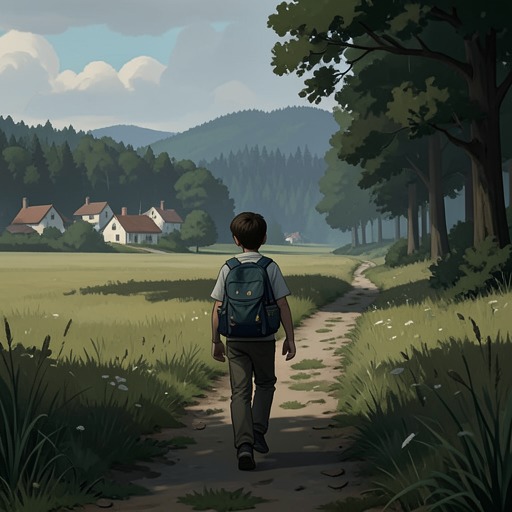
The boy lives in Marta’s hut expecting his parents to come for him at any moment. Crying does not bring them back, and Marta pays no attention to his sobbing. She is therefore his host and immediate caretaker, but not a substitute parent offering reassurance. The mismatch between the boy’s desperate waiting and her apparent indifference gives their shared domestic life its defining emotional condition: he depends on her while remaining alone in his grief.
Marta’s body is described in deliberate, unsettling detail. She is old and permanently bent, hobbling with a gnarled stick; her uncombed hair has knotted into thick braids she calls elflocks. Her small face is deeply wrinkled, her skin reddish brown, and her withered body trembles. Disease has twisted the joints of her bony fingers, which continue to quiver, while her head nods on a long, scraggy neck. Her poor sight narrows to tiny slits beneath thick eyebrows. Tears run from her eyes, joining mucus and saliva, and the boy compares her appearance to a rotten puffball. This portrait establishes her physical frailty before illness and fire make that vulnerability central to the plot.
Folk Belief, Illness, and the Evil Eye
Marta interprets the world through folk magic and superstition. She believes that evil forces nest in the elflocks, twisting them and slowly bringing on senility. When the boy’s squirrel is killed by village boys, she does not seem to understand his account; instead, she mutters a prayer and casts an enchantment over the household to ward off death, which she says is lurking nearby and trying to enter. Her response is not an explanation of the boy’s loss but a ritual defense against the danger she believes the loss signals.
When Marta herself becomes sick, she complains of sharp pain beneath her ribs, where she imagines the heart to be caged forever. She attributes the disease to either God or the Devil, each capable of sending it to destroy another being and end her life on earth. The boy proposes that she shed her skin like a snake and begin again. She angrily rebukes him as a blasphemous Gypsy bastard, kin to the Devil, and explains that disease can arrive by air, water, contact with animals or people, or through the look of a person with black eyes and a hawk nose. Such eyes, she believes, can bring crippling illness, plague, or death. She forbids the boy to look directly into her eyes or those of the household animals, ordering him to spit three times and cross himself if he does so accidentally. Her rules make ordinary acts of looking into moments of danger, and show how her fear shapes the boy’s conduct as well as her own.
Death and the Burning Hut
One morning the boy finds the hut cold, the stove extinguished, and Marta sitting in the middle of the room with her skirts tucked up and bare feet in a bucket of water. She does not answer when he tries to speak. Her hand is cold and stiff; when he lifts her head, her watery eyes seem to stare upward. Yet he decides that she may be waiting to change her skin, like the snake he had imagined, and tries to be patient. His interpretation is a consequence of the beliefs she has taught him, but it also exposes the distance between a child’s reasoning and the physical evidence before him.
The fire grows while Marta remains motionless. Flames climb the walls, reach her hands, and move toward her matted hair. When the blaze forms a peaked crown on her head, the boy sees her become a torch; the bucket hisses as pieces of her ragged rabbit-fur jacket fall into the water. He calls to her once more and runs outside. The danger has become unmistakable, but he still wonders whether her charms and incantations have made her immune to the fire.
Outside, the household’s animals respond in alarm: the hens beat their wings in the adjoining coop, and the cow butts at the barn door until it breaks through. Rather than wait for Marta’s permission, the boy frees the hens, which rush out and attempt to fly. The cow moves to a safer distance and chews its cud as the hut becomes a furnace, flames escaping through windows and holes and the thatched roof catching from below. The boy’s rescue of the animals is a concrete action taken in the crisis, sharply contrasting with his earlier, futile waiting for Marta to move.
Narrative Role and Significance
Marta’s role combines shelter with fear. The hut keeps the boy alive through a period of separation, but its everyday protections are inseparable from the beliefs that make sickness and death seem omnipresent. Her spells do not prevent her illness or the fire; the boy’s final uncertainty about their power leaves the scene suspended between magical explanation and the plain destruction of a body and home. The narrative does not give Marta a recovery or a deliberate final act. Instead, it follows the boy’s gradual recognition of danger through stillness, heat, and flame, while his belief that she may transform delays his understanding of what is happening. Her story thus marks a further loss for a child already bereft of his parents and companion, and makes the hut—first a place of refuge, then a burning enclosure—the setting for that loss.